Introduction & Significance of Perlite in Petroleum Engineering
Perlite is an amorphous volcanic glass formed naturally in the Earth's crust over geological eras. Once mined, raw ore undergoes thermal expansion in specialized industrial furnaces at temperatures exceeding 850°C. Trapped structural moisture vaporizes instantly, popping the mineral into white, ultra-lightweight, and highly porous granules.
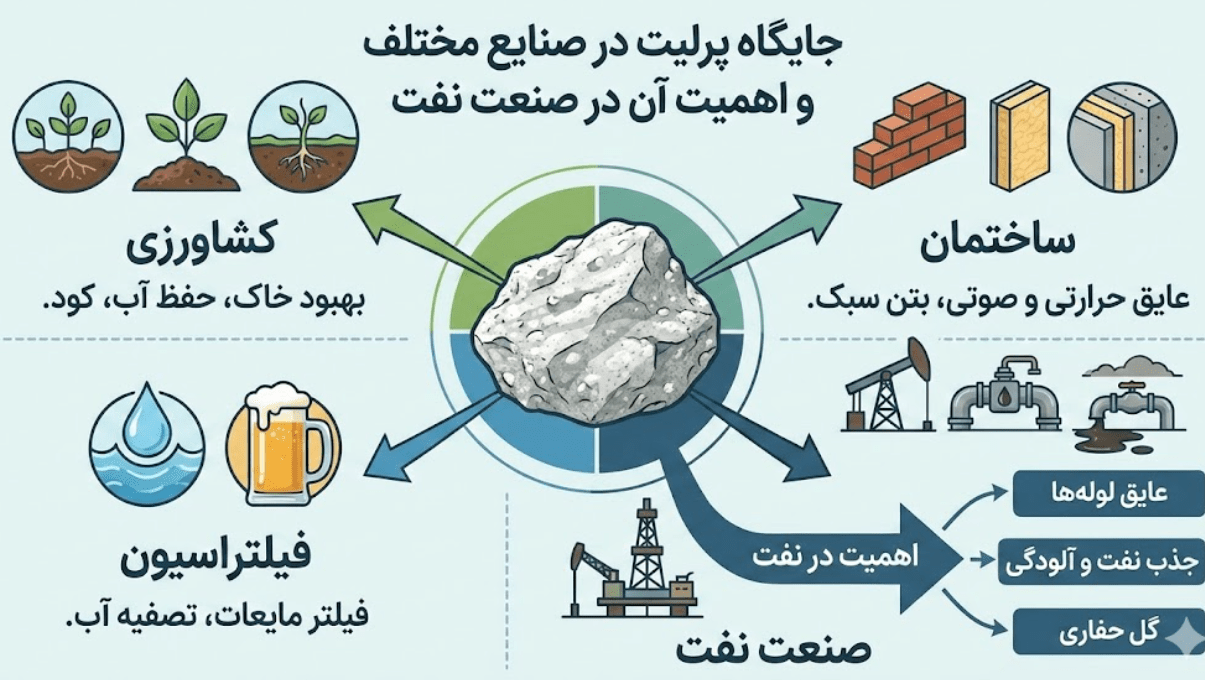
Beyond its light unit weight, perlite's porous architecture delivers an extraordinarily large surface area per unit volume. This structural profile makes it exceptionally well-suited for industrial filtration, thermal insulation, and fluid sorption. Consequently, refined perlite engineered at Esfahan Perlite Complex occupies a vital position across modern heavy industries, especially within petroleum operations.
Strategic Importance in Refineries & Petrochemical Works
Across refinery and petrochemical facilities, expanded perlite performs two vital functions: acting as a high-efficiency filter aid to strip impurities from liquid hydrocarbon fractions, and serving as a loose-fill refractory medium for insulating high-temperature reaction columns, pipelines, and cryogenic storage tanks.
Furthermore, perlite offers rapid hydrocarbon sorption during environmental spill incidents. Sourced from pure deposits processed by Esfahan Perlite Factory, perlite provides a safe, chemically inert, and cost-effective material that elevates operational efficiency, safety, and environmental compliance in the oil sector.
Cellular matrix of expanded perlite granules providing high surface area for hydrocarbon sorption and thermal resistance
Key Physical & Chemical Properties for Petrochemical Use
Selecting appropriate materials for hazardous petrochemical environments requires evaluating strict physical and chemical metrics. Refined perlite meets these stringent requirements:
1. Micro-porous, Lightweight & Refractory Matrix
Following thermal expansion at Esfahan Perlite Complex, perlite exhibits a cellular matrix with low bulk density. This multi-pored structure creates an extensive internal surface area, maximizing contact efficiency during filtration and liquid absorption. Composed predominantly of inert silica, perlite withstands extreme thermal conditions without melting or structural degradation.
2. Chemical Inertness & Universal Corrosion Resistance
A core technical advantage of expanded perlite is its neutral pH (7.0). It remains completely inert when exposed to most industrial chemicals, weak acids, or alkalis, preventing unwanted catalytic reactions or contamination of filtered fuels. In corrosive refinery settings, perlite's resistance guards equipment longevity.
3. High Thermal & Acoustic Dampening
Millions of microscopic dead-air pockets within expanded perlite yield extremely low thermal conductivity. In petrochemical plants, perlite insulates high-temperature process lines as well as cryogenic tanks, reducing heat transfer and saving energy across extreme operational temperature ranges.
| Technical Category |
Core Parameter |
Practical Industrial Benefit |
| Industrial Uses |
Multi-Sector Utility |
Deployed in agriculture, construction, filtration, and oil & gas |
| Petroleum Utility |
Strategic Integration |
Enhances process efficiency, lowers costs, and improves plant safety |
| Physical Matrix |
Porosity & Light Density |
High surface area ideal for mechanical filtration and liquid sorption |
| Refractory Endurance |
Thermal Stability |
Endures continuous high heat (~1100°C) without physical decay |
| Chemical Profile |
Neutral & Corrosion-Free |
Zero reactivity with fluids; protects equipment against corrosion |
| Insulation Grade |
Thermal & Acoustic Barrier |
Cuts HVAC/fuel loss, dampens machinery noise and vibrations |
| Fluid Filtration |
Solid-Liquid Separation |
Removes particulates, waxes, and oil traces from refined fuels |
| Wastewater Clean-Up |
Ecological Safety |
Strips emulsified oils from industrial effluent prior to discharge |
| Equipment Jacket |
Cryogenic Insulation |
Insulates LNG and liquid gas tanks at sub-zero temperatures (-240°C) |
| Spill Containment |
Sorbent Action |
Rapidly absorbs oil spills on soil or water without chemical hazards |
Specialized Applications Across Oil & Gas Sectors
Engineered particle grades manufactured by Esfahan Perlite Company serve critical functions across upstream exploration and downstream refining operations:
1. Liquid Hydrocarbon Filtration & Fuel Refining
Micronized perlite powder acts as a premier filter aid in refineries. Coated as a precoat layer on pressure leaf filters, perlite traps microscopic solids, tars, and gums from crude streams, lube oils, and wax products, elevating final fuel purity.
2. Refinery Effluent & Industrial Wastewater Treatment
Petrochemical effluents carry emulsified oils and organic contaminants that require removal prior to environmental release. Perlite filter beds capture free and emulsified oil droplets, enabling water reuse within plant cooling loops.
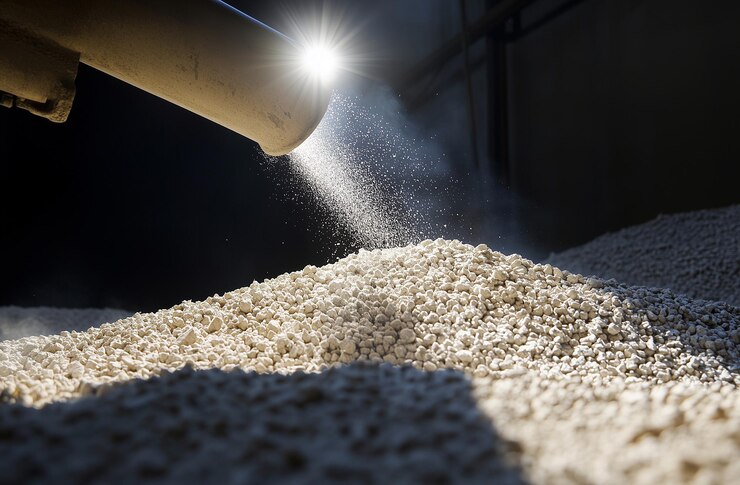
Micronized perlite utilized as a precoat filter aid in refinery filtration systems for fluid clarification
3. Cryogenic Equipment Insulation & LNG Storage Tanks
In liquefied natural gas (LNG), liquid oxygen, and nitrogen facilities, double-walled cryogenic storage vessels maintain liquid gas states at temperatures as low as -240°C. Bulk expanded perlite fills the annular jacket space, creating an effective loose-fill barrier that prevents boil-off losses.
4. Emergency Oil Spill Response & Environmental Remediation
In offshore or onshore pipeline ruptures, perlite works as a non-toxic sorbent. Because expanded perlite granules float and exhibit strong oleophilic (oil-attracting) properties, distributing perlite over oil slicks rapidly binds free hydrocarbons for easy mechanical retrieval without leaving secondary chemical pollutants.

Rapid absorption of surface oil slicks using bulk expanded perlite sorbents without secondary chemical pollution
5. Petrochemical Catalyst Filtration
In catalytic cracking and polymerization units, perlite precoat filters recover fine catalyst particles from process streams. This maintains reaction slurry purity and protects downstream heat exchangers from fouling.
Comparative Analysis: Perlite vs. Alternative Sorbents & Insulators
Evaluating perlite against traditional industrial materials highlights its technical and economic advantages:
Expanded Perlite vs. Fiberglass (Thermal Insulation)
Perlite is lighter, 100% natural, and completely free of irritating fibrous dust. It offers superior structural stability under direct flame exposure up to 1100°C without melting. Fiberglass, while low-cost, is prone to moisture absorption, sagging, and skin/respiratory irritation during installation.
Expanded Perlite vs. Zeolite (Industrial Filtration)
Perlite features a multi-pored structure ideal for capturing suspended solids, waxes, and insoluble oils across high-flow filtration lines at economical pricing. Zeolite excels in ion-exchange processes but incurs significantly higher material costs. For bulk filtration, perlite remains the cost-effective choice.
Expanded Perlite vs. Synthetic Chemical Absorbents (Spill Control)
Perlite is a 100% natural, non-flammable mineral sorbent that produces zero chemical hazards during disposal. Polymer sorbents absorb quickly but are costly, flammable, and pose environmental disposal challenges. Perlite offers a green, affordable remediation alternative.
Summary & Factory Inquiries
Expanded perlite stands out as a lightweight, chemically inert, refractory mineral aggregate essential to modern oil and gas operations. Its performance in hydrocarbon filtration, cryogenic tank insulation, and environmental spill response provides tangible economic and safety advantages.
Backed by accredited XRD and XRF laboratory testing and four decades of engineering mastery, Esfahan Perlite Company delivers standardized perlite grades tailored to meet the demanding requirements of domestic and international petroleum enterprises.
Hello. We utilized Esfahan Perlite filter aid powder in our refinery effluent treatment unit. Water clarification was exceptional, and suspended oil droplets were separated cleanly without blinding the filter bed. Excellent quality.
Greetings Eng. Hosseini. We are delighted that our filtration grade perlite met your strict refinery standards. Our micronized grades are screened specifically for oil-water separation with zero chemical contamination. Best regards, Factory Editorial Team.
What grain size is recommended for cryogenic insulation of double-walled liquid nitrogen tanks, and how is it pneumatically injected?
Hello Mr. Mahdavi. For cryogenic insulation, bulk expanded fine perlite with low compacted density is blown pneumatically into the annular jacket to establish an unbroken vacuum insulation matrix. Our engineering team is available for technical support. Best regards, Factory Editorial Team.