Introduction & Soil Management Challenges in Farming
One of the most persistent bottlenecks in traditional agriculture lies in poor soil structure and inefficient moisture management. Heavy compaction, inadequate drainage, and excessive water evaporation prevent plant roots from receiving essential oxygen and hydration. These deficiencies not only diminish crop productivity but also inflate irrigation costs and fertilizer waste.
In recent years, modern agriculturalists and greenhouse managers have turned toward sustainable, natural soil conditioners. Among the most effective solutions is expanded perlite — a lightweight, completely inorganic volcanic mineral refined at Esfahan Perlite Complex that transforms soil dynamics. With its distinct ability to enhance porosity, retain balanced moisture, and prevent root suffocation, expanded perlite stands as a premier soil amendment for sustainable crop yields.
Comprehensive Overview of Agricultural Perlite Uses
The table below provides a concise technical summary of expanded perlite specifications and mixing guidelines for agricultural practices:
| Parameter |
Technical & Practical Summary |
| What is Perlite? |
Expanded volcanic rock, extremely lightweight, porous, sterile, and pH-neutral; does not alter soil acidity. |
| Key Characteristics |
Low bulk density, excellent aeration, moisture retention, optimal drainage, disease/fungal resistance, thermal insulation. |
| Soil Amendment Benefits |
Prevents compaction, improves oxygen turnover, ensures uniform moisture dispersion, maintains soil temperature balance. |
| Impact on Root Systems |
Accelerates root development, prevents rot, optimizes nutrient absorption, increases crop yield. |
| Agricultural Applications |
Greenhouses, outdoor farming, clay soil conditioning, hydroponics, cuttings propagation, nursery beds. |
| Recommended Ratios |
Field soil: 20–40% • Cuttings: 50% • Mix with cocopeat/peat moss: 30–50% depending on crop type. |
| Greenhouse Usage |
Blended with cocopeat or peat moss for enhanced aeration and consistent moisture delivery. |
| Hydroponic Use |
Serves as a standalone or blended substrate due to its sterile and micro-porous structure. |
| Best Operational Practices |
Combine with organic fertilizers/nutrient solutions; apply gentle irrigation; replace degraded media periodically. |
| Common Pitfalls |
Over-application (causes over-drainage), using without organic nutrients, high-pressure irrigation, failure to refresh media. |
| Economic & Eco Benefits |
Reduces water and fertilizer usage, boosts crop performance, preserves soil longevity; 100% natural and sustainable. |
What is Perlite and How Does it Benefit Farming?
Perlite is an amorphous volcanic glass that expands dramatically when heated to temperatures around 850°C to 900°C. Trapped water molecules within the raw ore vaporize, causing the material to pop like popcorn into tiny, white, glass-like granules filled with microscopic air cells. This cellular structure gives expanded perlite its unique physical properties.
Processed under strict quality controls at Esfahan Perlite, agricultural perlite features exceptionally low density, insulation properties, sterility, and resistance to pest infestation or fungal decay. It is neutral, odorless, and chemically inert, making it fully compatible with various organic and synthetic soil mixes without altering pH balances.
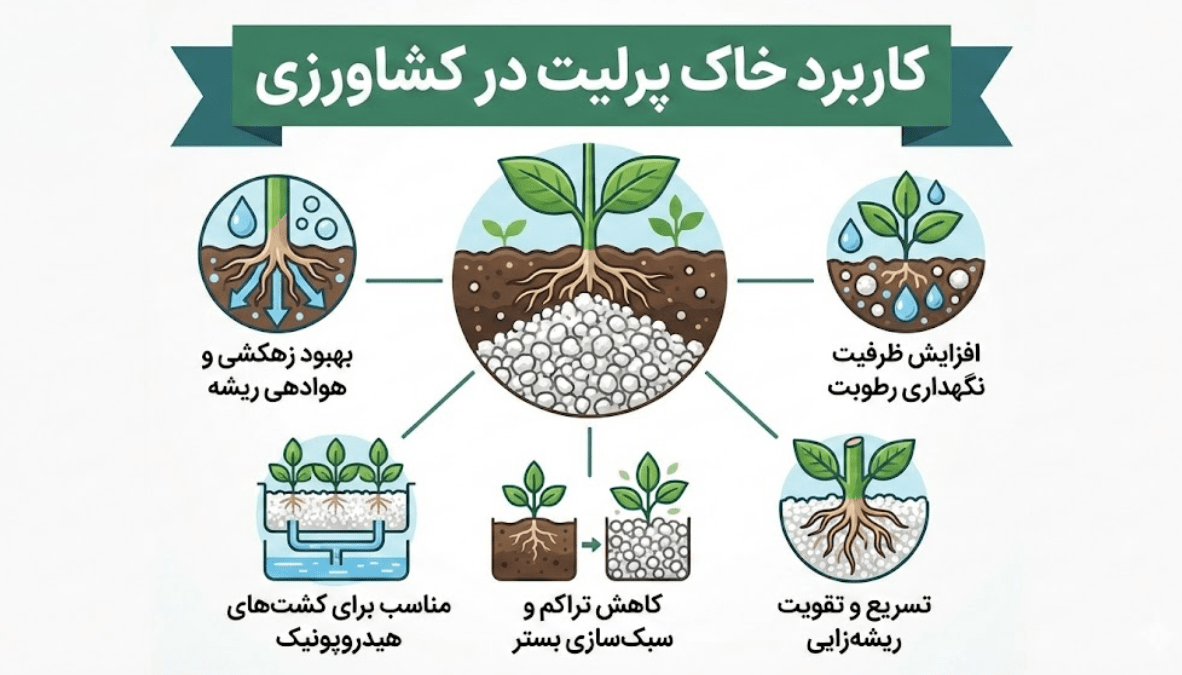
High porosity of agricultural perlite balances water retention while facilitating root respiration
The key advantage of perlite in agriculture stems from its microscopic capillary cavities. It acts like a capillary reservoir, storing moisture and soluble nutrients while simultaneously preserving essential oxygen pockets between soil particles. This dual action prevents soil crusting and waterlogging, fostering vigorous root development and higher overall crop quality.
Role of Perlite in Soil Amendment & Root Health
Soil aeration and bulk density dictate how freely root networks can expand. Compacted clay soils inhibit gas exchange, leading to root suffocation and increased susceptibility to anaerobic pathogens. Incorporating expanded perlite fundamentally restructures dense soils.
By creating a stable, physical matrix, perlite prevents soil particles from tightly binding together. It allows excess irrigation water to drain freely while holding appropriate capillary moisture for plant uptake. Furthermore, its insulating properties buffer soil temperatures against extreme ambient fluctuations, protecting delicate root tips from thermal shock in high-heat climates.
Utilizing agricultural grades from Esfahan Perlite Factory ensures stronger root anchorage, faster nutrient uptake, and superior drought tolerance across diverse crop varieties.
Applications Across Agricultural Sectors
Expanded perlite is widely adopted across various modern agricultural and horticultural domains:
1. Greenhouse Cultivation & Open-Field Farming
In greenhouse production, blending perlite into soil or substrate mixtures creates a lightweight growing medium with optimal air-filled porosity. In open-field agriculture, amending tight clay soils with coarse perlite improves water infiltration, reduces crusting, and ensures deeper root penetration.
2. Hydroponic Growing Media
Because perlite is sterile, inert, and structurally stable, it serves as a top-tier substrate for hydroponic systems (slab, Dutch bucket, or drip systems). It can be used as a standalone substrate or blended with cocopeat or peat moss to tailor water-holding capacities.
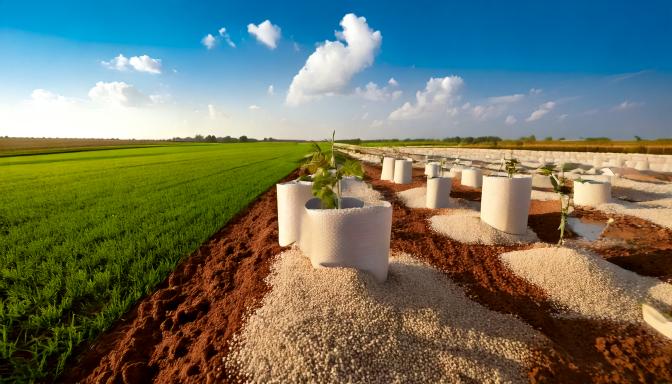
Perlite as an inert, sterile substrate in high-tech commercial hydroponic setups
3. Nursery Propagation & Cutting Rooting
For plant propagation and seed germination, fine to medium grade perlite offers a pathogen-free environment that maximizes oxygen availability around delicate stem tissue, minimizing damping-off risks and speeding up root initiation.
Recommended Mix Ratios & Directions
Application methods vary depending on crop requirements, climate, and initial soil texture:
- Field Soils: Blend 20% to 40% perlite by volume into the top 15–20 cm of root-zone soil or compost.
- Heavy Clay Lands: Incorporate coarse perlite to break up clods and enhance internal drainage capacity.
- Greenhouse Mixes: Mix 30% to 50% perlite with cocopeat or peat moss for lightweight container culture.
- Hydroponic Substrate: Utilize 100% perlite or a 50/50 mix with cocopeat depending on irrigation cycle frequency.
- Cutting Propagation: Use pure perlite or a 1:1 ratio with peat moss for rapid, sterile root formation.
Common Mistakes to Avoid
While perlite significantly improves soil texture, avoiding these common missteps ensures optimal results:
1. Excessive Ratios: Adding too much perlite without sufficient moisture-retaining organic matter can lead to overly rapid drainage and dry root zones.
2. Omitting Nutrients: Perlite contains no inherent plant nutrients. It must be paired with fertile compost, organic fertilizers, or hydroponic nutrient solutions.
3. Over-pressurized Irrigation: High-pressure water jets can float low-density perlite particles to the soil surface. Use gentle drip or misting systems.
Summary & Direct Factory Inquiries
Expanded perlite stands as a cornerstone of modern, high-efficiency agriculture. Its ability to balance aeration, drainage, and moisture retention creates an unbeatable soil environment for commercial growers.
Whether for open-field conditioning, greenhouse container crops, or hydroponic installations, products from Esfahan Perlite Company deliver consistent quality, competitive pricing, and technical reliability.
Hello. We utilized a 30% Esfahan Perlite / 70% cocopeat mix in our hydroponic tomato cultivation. Substrate drainage was outstanding with zero clogging in drip emitters. Thank you for the high quality control.
Greetings Eng. Taheri. We are pleased that our agricultural perlite met your commercial expectations. Our 3-5mm grade is screened dust-free specifically to prevent drip emitter clogging. Best regards, Factory Editorial Team.
How much perlite is recommended for conditioning heavy clay farm soil? Do you offer freight delivery to Mashhad?
Hello Mr. Naderi. For dense clay soils, a 20% to 30% volume ratio in the tilled layer is recommended. Yes, direct shipments are dispatched daily from Najafabad, Esfahan to all locations, including Mashhad. Please contact +98 912 044 5338 for logistics details.